

A 5-year ceramic coating is a professionally applied coating built to protect your paint for roughly three to five years, sometimes longer, when it goes on over properly prepared paint and is washed correctly. The number is a service-life estimate, not a guarantee that applies to every car. Your results depend on the paint underneath, the prep work, the climate and how the car is washed. In Allen and the rest of Collin County, the simplest way to get it right is to have a detailer prepare and coat the car at your home or office, so the vehicle never has to sit in a shop for days.
TL;DR
- “5-year” describes expected service life under good care. No regulator defines it, so the prep, the installer and your wash habits matter more than the label.
- Professionally applied coatings are generally rated at 3 to 5 years, and most last 2 to 5 years or 30,000 to 50,000 miles with proper maintenance, according to Autotrader.
- Paint correction before coating is often what separates a flawless result from a sealed-in flaw. Raven’s 1-Step Correction starts at $599 and 2-Step Correction at $849.
- Our coatings use GYEON and last between 3 and 10 years depending on the package, applied mobile at your home or workplace in Allen and nearby areas.
- Hand wash with a gentle method and skip automatic brush washes to keep the coating performing.
Table of Contents
- What “5-year ceramic coating” actually means
- How long a ceramic coating lasts in real use
- 3-year, 5-year and 10-year coatings: what changes
- Why preparation decides the result
- What a professional 5-year ceramic coating costs in the US
- Mobile application: coated at your home or office
- Book your ceramic coating with Raven
- Keeping a coating performing for years
- How to choose between 3, 5 and 10 years
- FAQ
- Sources
What “5-year ceramic coating” actually means
A ceramic coating is a liquid, usually silica-based, that cures into a thin, hard layer on top of your clear coat. It makes the surface slick, causes water to bead and roll off, and helps resist bird droppings, road film, UV and light chemical contact.
The year number on the bottle or the quote is a marketing and warranty term. It is usually an expected service life under certain conditions, not a quality score. A 5-year coating is not automatically five times thicker, harder or more scratch-resistant than a 1-year product, a point made in Dr. Beasley’s October 2026 comparison of 1-, 3- and 5-year coatings.
There is also no independent body that certifies what “3-year,” “5-year” or “10-year” means. Lab test methods exist, but they do not translate into calendar years, a distinction explained in this 2026 breakdown of durability claims. Lab tests are good at ranking one coating against another. They are poor at predicting how long a specific car will keep its performance, because the paint, the climate and the washing habits all change the wear.
So the practical question is not “which number is biggest.” It is “who is preparing my paint, which product are they using, and how will I care for it.”
How long a ceramic coating lasts in real use
Autotrader’s August 2026 guide puts the general range at 2 to 5 years, or 30,000 to 50,000 miles, with proper maintenance. It sorts coatings roughly like this:
| Type of coating | Typical lifespan |
|---|---|
| Professional, cured coating applied by an installer | 3 to 5 years, up to about 50,000 miles |
| Consumer bonded coating | 2 to 3 years |
| DIY spray | 4 to 6 months |
Those figures come from the Autotrader ceramic coating lifespan guide. Two things stand out. First, the professional category is where the 3 to 5 year numbers live. Second, the lifespan is tied to mileage and maintenance as much as to the calendar.
A car that sits in a garage and gets a careful wash every two weeks is in a different situation than a daily commuter on Highway 75 that sees summer sun, hail season and long stretches of road film. The same coating will age differently on each.
3-year, 5-year and 10-year coatings: what changes
People searching for a 3-year or 10-year coating are asking the same underlying question: how much protection do I want to buy, and for how long? Here is what usually separates the tiers.
Formulation and layers. Longer-rated coatings often use more robust chemistry, and some are applied in multiple layers. More layers generally mean more time on the job and a higher price.
Prep requirements. The longer the rated life, the more it matters that the paint is perfectly clean, decontaminated and corrected before application. A coating bonds to the surface it is given. Poorly prepared paint shortens the life of any tier.
Hardness and cure. Cured ceramic coatings are rated at 7H to 10H on the pencil hardness scale, compared with roughly 4H to 5H for clear coat. Curing takes 24 to 48 hours initially, with full hardening over two to three weeks, according to GYEON USA’s guide to ceramic coating. Hardness helps resist light marring, but it does not make paint immune to scratches.
Warranty and maintenance terms. A longer rating often comes with a maintenance schedule. Read what is expected of you, because that is part of what the number really means.
At Raven, coatings last between 3 and 10 years depending on the package, and we apply GYEON ceramic coatings. If you are weighing a 3-year, 5-year or 10-year option, the useful conversation is about how you drive, where the car lives and how much you want to invest, not about chasing the biggest number.
Why preparation decides the result
A ceramic coating does not hide paint defects. It seals what is underneath. If there are swirl marks, light scratches or water spots in the clear coat when the coating goes on, they are locked in beneath a hard, glossy layer. USA Today’s 2025 report notes that coatings cannot remove swirls or scratches, and that coating over damaged paint seals the imperfections in.
That is why professional application follows a sequence:
- Wash and decontaminate. A thorough wash removes loose dirt, then chemical and mechanical decontamination (iron removal and a clay treatment) lifts the bonded contaminants that make paint feel rough.
- Correct the paint. Polishing removes swirls, hazing and light scratches so the coating locks in a clean, glossy finish.
- Panel wipe. The surface is degreased so the coating bonds directly to the paint.
- Apply and level. The coating is applied panel by panel, then leveled and wiped before it flashes and cures.
- Cure. The car stays dry while the coating hardens.
The correction step is where time and cost vary. Newer cars in good shape may need only a light one-step polish. Older paint, black or dark colors and cars that have seen automatic car washes often need more.
Our correction pricing is published: 1-Step Correction starts at $599 and 2-Step Correction starts at $849, as listed on our detailing prices and packages page. A “from” price means the final figure depends on the vehicle’s size and the condition of the paint, which is why we look at the car before locking in the work.
What a professional 5-year ceramic coating costs in the US
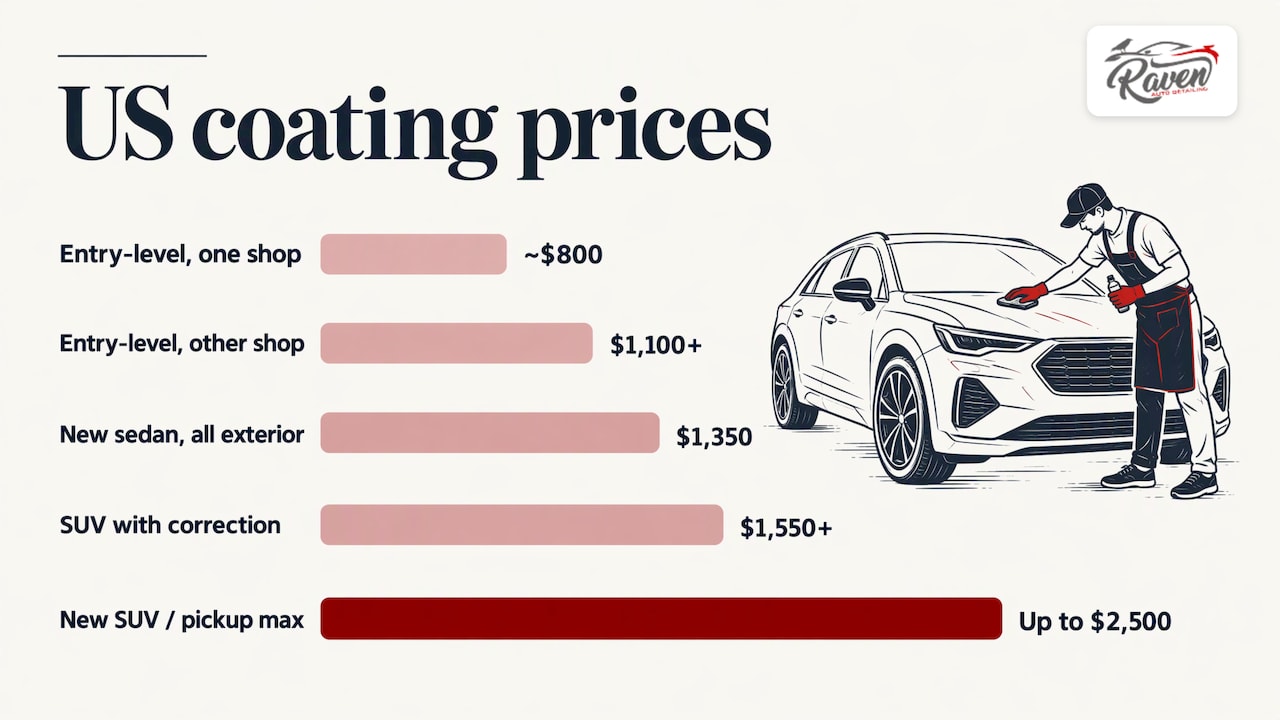
Nationally, prices are wide because the work is wide. Autotrader’s May 2026 cost guide reports that an entry-level coating on a new or well-kept car can start around $800 at one shop and $1,100 or more at another. It puts coating all exterior surfaces of a new sedan at about $1,350 and a new SUV or full-size pickup at up to $2,500, with extra fees for glass, headlights, wheels and trim. An SUV that needs decontamination and paint correction can top $1,550, according to the Autotrader ceramic coating cost guide.
Three things move the quote most:
- Vehicle size. A full-size truck takes more product and more hours than a coupe.
- Paint condition. Neglected paint can need extensive correction, sometimes doubling the job.
- Coating tier. Longer-rated products and added layers cost more.
A useful habit is to ask for an itemized quote that separates prep, correction and coating. That way you can compare two estimates on equal terms rather than comparing one all-in number with another.
A worked example
Imagine a three-year-old SUV with light swirling from regular automatic washes. The job would likely involve a full decontamination, a one-step correction to remove the swirls, and then the coating. A national average for that kind of work lands well above a basic wash and wax because the labor is in the prep. Seeing the car in person is what lets a detailer say whether one step is enough or whether the paint needs a second pass.
Mobile application: coated at your home or office
Traditional shops ask you to drop the car off, often for several days. We come to you. Raven Auto Detailing is a mobile service in Allen, TX, and we work throughout the surrounding area, including McKinney. For busy professionals that means no rides, no rental car and no losing a day to a drop-off.
If you live in Allen, our ceramic coating page for Allen, TX explains the service for this area, and the main ceramic coating page covers the coating options. The work is done with GYEON products, and our more than 300 five-star reviews come from customers across the area.
Because the coating needs a clean, dry environment while it cures, a garage or shaded driveway works best. That is something we plan around when we schedule the appointment.
Book your ceramic coating with Raven
If you are ready to protect your paint for the long haul, the next step is to pick the coating that fits how you drive and how long you plan to keep the car. We prepare the paint, correct it where it needs it, and apply the GYEON coating at your home or workplace. Packages and correction pricing are on our pricing page, and the coating itself is quoted on the ceramic coating page.
If your headlights are yellowed or hazy, we also offer headlight restoration, which pairs well with a full exterior refresh. Motorcycle owners can choose a Motorcycle Ceramic Coating for $499.
Keeping a coating performing for years
A coating is low-maintenance, not no-maintenance. These habits protect the rated life:
- Wait for the cure. Keep the car dry for the first day or two and avoid washing it until your installer says the coating has set. Full hardening takes two to three weeks, per the GYEON guide linked above.
- Wash by hand. Use a pH-neutral car shampoo, a clean wash mitt and soft microfiber towels. Gritty sponges and old towels put new scratches in a hard surface.
- Skip automatic brush washes. Brushes can mar paint and wear coatings, and USA Today lists them among the things a coating cannot withstand.
- Remove contamination quickly. Bird droppings, bug splatter and tree sap are best lifted soon after they land, before they sit in the Texas sun.
- Decontaminate periodically. Rail dust and road film can still bond to a coated surface. If the paint starts to feel gritty, it usually needs a decontamination wash, not a new coating.
- Keep it parked smartly. Shade and a garage reduce UV and heat cycles on any finish.
Coating also does not stop rock chips, and it does not prevent rust. Treat it as a hard, slick layer that makes the paint easier to keep clean and keeps its gloss, rather than as armor.
How to choose between 3, 5 and 10 years
Use these questions to decide:
- How long will you keep the car? If you plan to trade in within three years, a shorter-rated coating covers your ownership. If it is a keeper, a longer-rated one is a better fit.
- Where does it live? A car parked outside all day in North Texas heat faces more UV and weather than a garaged one.
- How do you wash? If you hand wash regularly, any good coating will serve you well. If you rely on drive-through washes, you will shorten the life of any coating.
- What condition is the paint in? Budget for correction first. A coating is only as good as the surface beneath it.
- How much do you drive? Mileage matters. Highway commuters accumulate more road film and rock strikes than occasional drivers.
Once you have those answers, the right tier is usually clear. If you are not sure, tell us about the car and how you use it and we will recommend a package.
FAQ
Is there really a 5-year ceramic coating?
Yes, but “5-year” is a manufacturer or installer rating for expected service life under good care, not a universal standard. Professionally applied coatings generally fall in the 3 to 5 year range, according to Autotrader. The result depends on preparation, climate and maintenance.
How much should a professionally installed 5-year coating cost?
Nationally, Autotrader’s 2026 cost guide reports roughly $800 to $1,100 or more for entry-level coating on a clean car, and up to $2,500 for a large new SUV or pickup. Paint correction, vehicle size and extra surfaces like glass and wheels change the quote. For a Raven quote, our correction pricing starts at $599 for 1-Step Correction.
Does a ceramic coating make my car scratch-proof?
No. A cured coating is harder than clear coat and resists light marring, but it does not stop deep scratches, rock chips or damage from brush car washes. It also cannot remove existing swirls, which is why correction comes first, as USA Today notes.
How long before I can wash the car after coating?
Plan on keeping the car dry for the first 24 to 48 hours while the initial cure sets, and follow your installer’s instructions on the first wash. Full hardening takes about two to three weeks, according to GYEON USA.
Can Raven coat my car at my home in Allen?
Yes. We are a mobile service, so we come to your home or workplace in Allen and nearby areas. See the Allen ceramic coating page for details.
Sources
- How Long Does Ceramic Coating Last? (Autotrader)
- How Much Does Ceramic Coating Cost? (Autotrader)
- Does ceramic coating your car really protect its paint? (USA Today)
- The Complete Guide to Ceramic Coating for Cars (GYEON USA)
- 1-Year vs. 3-Year vs. 5-Year Ceramic Coatings (Dr. Beasley’s)
- What Do 3-Year, 5-Year, and 10-Year Durability Claims Actually Mean (Nasiol)